

BANGKOK, Mar 21 – For many years Southeast Asia had a bountiful supply of elephants to satisfy Thailand’s ivory traffickers, but the decimation of the species has seen them turn to Africa for their plunder.
The more than 1,600 tusks seized since the beginning of 2009 by Thai customs indicate that more than 800 elephants were slaughtered to feed a murky and voracious international market.
"Thailand is still ranked number one" in the ivory traffic rankings, said Chris Shepherd, deputy manager for Southeast Asia at wildlife protection group Traffic.
International trade in ivory was banned in 1989, but seizures have risen dramatically in the past five years.
Experts say the trade is passing through organised networks often linked to the smuggling of rare animals from Mozambique, Tanzania or Kenya.
"When you order ivory for decoration, one elephant will be killed — the killer is demand," said Lieutenant Colonel Adtapon Sudsai, investigation chief at the Natural Resource and Environment Crime Suppression Department.
Some of the ivory imported — sometimes delivered without even being cleaned of the elephant’s blood — is destined for the Thai market.
Certain "businessmen or senior government officers" in the kingdom like to hang large mammals‘ tusks on their walls as a symbol of their power, notes Seri Thaijongrak, director of the Royal Thai Customs‘ investigation bureau.
Tourists also enjoy looking at the jewels and small animals carved by specialist craftsmen in northern Nakhon Sawan province, who worked traditionally with the ivory of Thailand’s native elephants.
Thailand’s ivory sculpting tradition started in the late 19th century when an estimated 100,000 elephants roamed the kingdom. Since then most have been lost to poachers and the clearing of their forest habitat.
Now just a few thousand remain — many of them working in the tourism industry — and the ivory traffickers have turned to the pachyderms‘ African cousins to meet considerable Asian demand.
Benefiting from its location, Thailand exports much of the ivory, rough or carved, to China — where it is traditionally used in medicinal powders — and Japan. But some also ends up in the United States and Europe.
Critics say the authorities need to take tougher action.
"We are not seeing significant prosecutions," said Justin Gosling, of Interpol’s environmental crimes department in the Asia-Pacific region.
"Seizures must be met with prosecutions, and not (just) prosecution of the transporters, poachers and consumers, but the key people controlling this trade," he added.
Experts are pessimistic about justice being done, with a lack of communication between Bangkok and relevant African authorities and inadequate training of the customs and police officers.
"Wildlife crime in these parts of the world still is not seen as a priority," said Shepherd.
When financial means exists, they are on the wrong side of the battle, experts say, with much remaining to be done against corruption.
"In order to smuggle these huge quantities, there need to be corrupt officials involved in this," insists Gosling.
The local press recently reported on the disappearance of ivory stocks in a customs warehouse, an incident that does not appear isolated.
But even the most optimistic admit that the fight is a difficult one.
The ivory confiscated by customs since 2009 is worth nearly 250 million baht (nearly six million euros), and such success means the traffickers "will probably change their tactic," said Gosling.
In anticipation of such a switch, customs officials — who recently made seizures at a Bangkok airport — have been reinforcing controls at ports, said Seri — but he warned it was hard to keep up.
"We are always one step behind them," he said. "Maybe many steps behind."
Kenya – A mammoth task: Rangers sedate and fit GPS tracking devices on migrating elephants
A group of men haul an elephant up, back on to his feet, having tranquillised the beast before sending him, and seven chums, on their way again.
For the first time in 40 years the Kenya Wildlife Services undertook the project in Tsavo East National Park this week, as they want to track the elephants‘ migration routes.
Using GPS technology KSW collared the sedated elephants – who are eight of nearly 13,000 in the park – with the help of the Animal Fund for Animal Welfare (IFAW), in the park 30km south-east of Nairobi.
Having marked the male and female beasts, the tracking devices will assist in the mapping out of migratory routes and corridors in the park and its buffer zones within the larger ecosystem.
Located in different parts of the park, which is a massive 13,747 square kilometres, the tagged elephants will be closely monitored for 20 months – as long as they retain the collars.
The collars themselves will enable the KWS to effectively design intervention measures for security operations and human-elephant conflict mitigation.
The last collaring in Tsavo East was done in 1972 using conventional collars that required manual tracking with radio transmitters.
IFAW President and CEO Fred O’Regan believes that the tracking is very important for elephant management and conservation.
He said: ‚The cost of losing elephants and other wildlife and their habitats is more costly than securing them.
‚IFAW recognises that Tsavo is a major lifeline for elephants and Kenya as a whole.
‚It is therefore vital for KWS and ourselves to know which migratory areas are most critical for elephant survival so as to secure those areas, as well as reduce conflict incidences with humans.‘
A recent aerial census conducted last month established 12,572 elephants, an increase from 11,696 in 2008.
The fluctuation of Tsavo’s elephant populations over the decades has had significant impacts on the ecology of the ecosystem.
In 1967, the ecosystem had some 35,000 elephants while about 5,400 individuals were left in 1988.
Heavy armed poaching and severe drought were responsible for this rapid decline. However since 1990s, concerted efforts by KWS and other conservation partners have seen elephant populations steadily increase to the current status.
Common challenges facing Tsavo’s management are poaching for ivory, human encroachment and habitat destruction, human-elephant conflict, livestock incursions into the Parks, and the adverse and emergent effects of climate change such as severe droughts.
Die Eli-Waisen im Februar
Monatsbericht für die Nursery-Gruppe
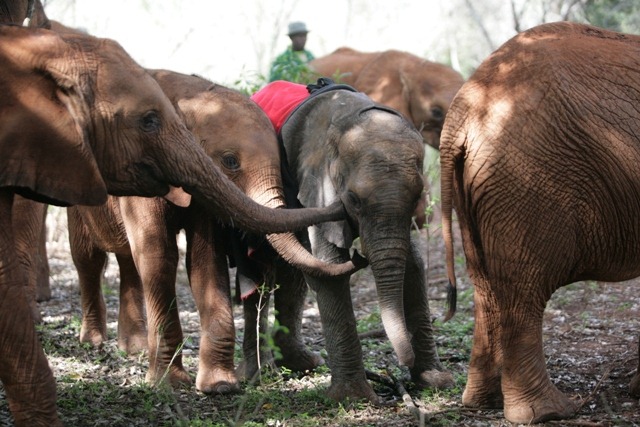
Der Februar war sehr dramatisch und traurig, denn zwei unserer Neuankömmlinge starben: Kulala am 7. und Kongit am 20. Februar. Am 22. Februar wurde Kainuk gerettet, ein Elefantenwaise aus der stark dezimierten Population im Schutzgebiet Turkana-Süd. Die Region wird von einem kriegerischen Hirtenvolk, den Pokot, bewohnt. Sie versuchen das Beste aus einem Leben in dieser extrem kargen Wüstenlandschaft zu machen. Die Stammesangehörigen sind (illegalerweise) bis an die Zähne bewaffnet, um ihre Rinder gegen Diebstahl zu schützen, was in diesem vergessenen Landstrich häufig vorkommt. Jetzt, da die chinesischen Gastarbeiter im Land sind, läuft auch der Schwarzmarkt für Elfenbein auf Hochtouren, so dass ein zusätzlicher Anreiz zur Wilderei von Nashörnern und Elefanten geschaffen wurde.
Newsletter aus MALAWI
Kenya: Narok Residents Kill Stray Elephant!
Residents of Olopito location in the outskirts of Narok town killed one of the 16 rogue jumbos that destroyed their crops. The elephants in search of water and pastures had destroyed an acre of maize.
The armed residents threatened to kill all the elephants saying the Kenya Wildlife Service failed to respond to their distress call. The KWS officials later arrived and chased away the jumbos.
The villagers accused the KWS officers of laxity in protecting their lives from the elephants saying several people have been injured by the jumbos. "We feared that the jumbos would attack us especially the children who are going to school and women who are fetching water," said Kerepei Nkuruna, one of the residents.
Narok senior warden Kenneth Naisho warned the residents against taking the law into their hands by killing the straying animals. He told them to report to the relevant authorities when wild animals invade their area.