
Kenya: How did the elephant cross the road? Underneath it!

NAIROBI, Kenya (AP)

image

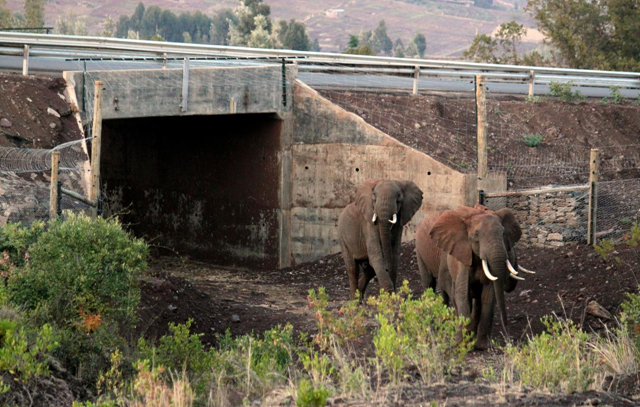
In this photo of Monday, Jan. 24, 2011, elephants exit Africa’s first dedicated elephant underpass near the slopes of Mt. Kenya. Conservationists say the tunnel connects two elephant habitats that had been cut off from each other for years by human development. (AP Photo/Jason Straziuso)

Dusk had settled on Mount Kenya’s forested slopes, and traffic had slowed to a trickle on the region’s major highway. That’s when three elephants crossed through Africa’s first dedicated elephant underpass — a new solution to the increasing problem of animal-human conflict in Africa.

It was 6:47 p.m. when a gleaming set of white tusks poked through the end of the newly built underpass. A second set of tusks appeared. Then a third. Moving cautiously, the three young males climbed a bank of dirt, made a sharp left turn and crashed into the forest.

The $250,000 tunnel — built with donor funds — has successfully connected two wilderness areas and two distinct elephant populations separated for years by human development. The elephants successfully crossed a major road without putting themselves or motorists in danger, and without damaging crops or scaring residents in a nearby village.

"The first time we had a report about an elephant going under the underpass it was very exciting. We didn’t expect it to happen so quickly," said Susie Weeks, executive officer of the Mount Kenya Trust, one of the partners in the tunnel project. "They actually managed to go through it within days of it being opened."

The 15-foot-high (4.5-meter-high) tunnel opened for elephant business around Christmas, and on Jan. 1 a bull elephant named Tony made the first crossing. Accompanied by two other young males, Tony moved through the underpass again on Monday as an Associated Press reporter captured the first ever photos and video of elephants making use of the underpass.

Africa’s wildlife is coming under increasing pressure from human development. Villages are being built and crops raised in areas that for centuries were animal wildlands. The new elephant underpass reconnected wilderness areas on Mount Kenya’s highlands and the lower forests and plains, linking 2,000 elephants on Mt. Kenya with 5,000 more below.

Iain Douglas-Hamilton, the founder of Save The Elephants, said the 9-mile (14-kilometer) man-made corridor that surrounds the tunnel allows elephants to move from low to high to search for food and mates. The fenced-in corridor will also help strengthen the elephants‘ gene pool. The overall corridor and tunnel project cost $1 million.

"All over Africa this incredible wildlife is increasingly being fragmented by the growing human population, and if African wildlife is to survive, solutions must be found of this nature, where connectivity is preserved through corridors," he said.

"I think it’s a good example of the compromises that can be made between human interest and the survival of wild animals," he added.

The underpass is somewhat pricey, Douglas-Hamilton said. Cheaper solutions will also need to be found, including points where traffic will be stopped so elephants can cross the road, he said.

Kenya’s elephant underpass may be the first in Africa but not the world. China and India have elephant underpasses, and India even has elephant overpasses. In the U.S., a winner was announced Sunday in a contest to design a highway wildlife crossing in Vail, Colorado aimed at reducing collisions between cars and deer, coyote and bighorn sheep.

In South Africa’s Addo Elephant National Park, which is fragmented by roads and railway lines, officials recently opened an elephant crossing over a road, said Megan Taplin, a park spokeswoman. She said officials have considered overhead bridges that are wide and full of vegetation to help elephants move around.

Kenya’s underpass was 10 years in the making, and didn’t gather much momentum until Richard Branson, owner of Virgin Atlantic, donated $250,000. The Dutch government kicked in more money and other donors stepped up. Two major farms allowed the corridor to cross through their land.

One of those family farms gave up 671 acres to the corridor. The elephants have already caused $25,000 in damage, but farm owner-manager Charlie Dyer said he is "just overjoyed and really, really satisfied" to see the underpass in use.

The project had many skeptics, people who feared the elephants wouldn’t walk through a tunnel that humans had built.

"So many people were wondering, are we putting good money into this?" said Weeks. But so far about three dozen elephants passes have been made, providing conservationists with the answer they were hoping for.

The tunnel sits in the rolling hills below Mount Kenya, near fields of young green wheat and bright yellow canola stalks. It was lined with hay and elephant dung to entice the animals through. The bucolic lands can be dangerous, though.

Poaching is on the upswing, fueled by demand for ivory in China. John Pameri, the senior warden at the Lewa Wildlife Conservancy, one of the partners in the underpass project, said poachers killed more than 30 elephants in northern Kenya in December. Because elephant tusks have increased in value, poaching is "really a big, big danger," Pameri said.

Save the Elephants has put GPS collars on several elephants and can track their movements. Three minutes after Tony crossed through the tunnel Monday, an automatic text message alert went out to people like Weeks and Douglas-Hamilton, who has since watched Tony climb to the top of the elephant corridor on a Save The Elephants Google Earth maps program.

"This particular corridor is almost a symbol. It’s a very high profile one under the peaks of Mount Kenya, and what happens there is important for Kenya and for Africa in terms of conservancy of elephants and biodiversity," Douglas-Hamilton said.
Source: www.google.com/hostednews/ap/article/ALeqM5jxOcuItiGlgm7LlEUZhbRNe-dzHg?docId=cffdba0c740a47d389843bde34d01eb3

Congo arrests Chinese ivory poacher

BRAZZAVILLE — Officials in Congo were on Sunday holding a Chinese national as he tried to smuggle 10 kilos (22 pounds) of ivory — including five large elephant tusks — out of Congo, a wildlife group said.

The 35-year old was arrested Saturday at Maya-Maya airport, in the capital Brazzaville, said Naftali Honig, coordinator of the Project to Apply the Law on Fauna (PALF).

Officials found five large elephant tusks, 80 ivory chopsticks, several hankos, or Chinese name seals, three 3 ivory carvings and many small ivory items, he added.

He was taking a flight bound for Beijing.

The Congolese paramilitary gendarmerie are holding the suspect, who faces up to five years in prison if convicted of the attempt to smuggle the wildlife artefacts.

"We vowed to help the government of Congo send a zero tolerance message to ivory traffickers, and as you can see this message is in action," said Honig.

Earlier this month five African poachers trafficking endangered species were arrested and put behind bars in Gabon.

On that occasion, officials seized 13 heads and 32 hands of apes, 12 panther hides, a lion hide, five elephant tails and numerous hides of other less endangered species, according to another wildlife group there.

It was the biggest ever seizure conducted in Africa concerning apes, according to Gabon’s AALF, known by its French acronym for Support for the Application of the Wildlife Act.

Copyright -© 2011 AFP. All rights reserved.


Source: www.google.com/hostednews/afp/article/ALeqM5gHCgL2xsB82_9h6865_M5_hUEddQ?docId=CNG.4f8b988b9ebd1a5c9a9eba1574013bc8.eb1

Kenia: Wilderer in Amboseli gefasst!

Ein großer Erfolg der vom berühmten Fotografen Nick Brandt ins Leben gerufenen BIG LIFE FOUNDATION zusammen mit dem KWS (der kenianischen Wildschutzbehörde): Die seit 20 Jahren agierende Wilderer – Gruppe, die viele Tiere in Amboseli, der angrenzenden Region und Tansania gewildert hat, ist dank dieser Organisationen endlich gefasst worden! Congratulations!!!
Der Bericht ist in englisch verfasst:

BIG LIFE BRINGS DOWN LEADER OF AMBOSELI’S WORST POACHING GANG, ELEPHANT KILLER FOR TWO DECADES

image 

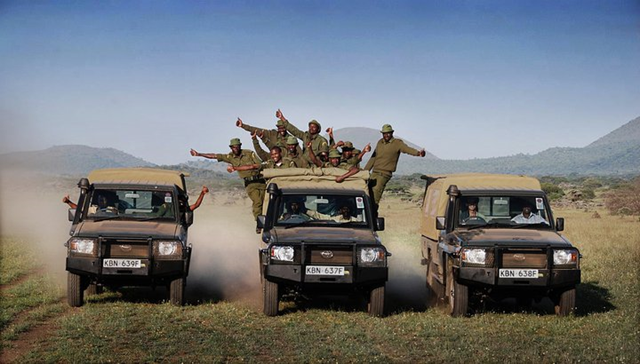
Foto: Nick Brandt, Big Life Rangers and Newly-Purchased Vehicles, December 2010

For twenty years, one poacher and his gang in Tanzania have been systematically poaching many of the Amboseli region’s elephants. The authorities have never been able to catch him. But thanks to Big Life & KWS, his poaching days are now over:
Seven weeks ago, I reported a continued escalation in poaching, another eight elephants killed in the Amboseli area alone in just 16 days. This included the old bull called Magna, whose broken tusks were so small, it showed that no elephant was safe from the poachers‘ bullets and poison.
Based on a tip-off from one of Big Life’s informers, Kenya Wildlife Service successfully intercepted the poaching gang responsible for the killing of Magna and many other elephants in the Amboseli ecosystem and Tanzania over the last twenty years. A firefight had ensued, during which two of the poachers were killed, but the leader of the poaching gang escaped with wounds over the border back into Tanzania.
The Kenyan authorities were not able to communicate as quickly as necessary with the authorities in Tanzania. At this point, Big Life’s strategy – of coordinated teamwork between our teams in Kenya and Tanzania – came into play. The Big Life team in Tanzania WAS able to respond, and immediately:
Critical information from one of Big Life’s informers in Kenya was passed on to the team in Tanzania from Honeyguide Foundation, our partner there. They were able to track down the gang leader, and with the help our network of informers there, followed him for a number of days. At the appropriate, safe moment, the Big Life/Honeyguide team brought in the Tanzanian police, who made the arrest. The gang leader now awaits extradition to Kenya, where he should receive a long prison sentence.
This poacher and his gang have been organizing and killing elephants for TWENTY YEARS, including what must be many of the elephants photographed in my books. But the authorities were never able to pin anything on him. Within three months of being established, Big Life has succeeded in breaking up the worst of the three main poaching gangs operating along the Amboseli region Kenya/Tanzania border.
This great success could not have been possible without the generosity of our donors who helped us purchase critical vehicles and equipment, hire anti-poaching teams, and develop our network of informers and associates.
Things are also going well with the capture of other poachers: In both Kenya and Tanzania in recent separate incidents, several poachers with newly-killed giraffe meat were arrested by Big Life rangers on night patrols.
As a result of Big Life’s efforts, there have been ZERO reports of any elephants being killed on either the Kenyan or Tanzanian sides of the border in the last six weeks. We have quickly sent out a strong, effective message to poachers that killing wildlife now carries a much greater risk of being arrested.
Of course, Big Life has invested a large amount of money establishing its teams in order to make a difference fast. We have achieved that goal, and we know our work is having an impact. However,there are still over two million acres to protect in the Amboseli ecosystem, and we have a long way to go financially to achieve SUSTAINABLE operations in both countries across this area.
To achieve our mission, Big Life must build and man a significant number of additional anti-poaching camps, with accompanying patrol vehicles and equipment. Our goal is a total of 160 rangers and scouts in 18 camps across the ecosystem. We are about halfway to that goal, and can get there with your help.
We’re not just attempting to protect the elephants, but also the diminishing populations of lions, giraffes, zebra and other plains animals also being hunted by the poachers. We may have brought down the most active of the three gangs operating along the Kenya-Tanzanian border of Amboseli, but there are the other two known gangs there, and all the other poachers operating in the other areas of this vast region. While the demand for ivory and all the other animal parts remain, there will be many who cannot resist the fast, easy profits to be made out of killing these irreplaceable creatures. With your help, we will be there to stop them, and allow the animals to flourish in peace once again.

Quelle: www.facebook.com/?sk=messages&ref=mb#!/photo.php?fbid=193207187357638&set=a.178446792167011.43792.154399394571751

Kenya: Chinese man sentenced for ivory possession

A Chinese man was sentenced Wednesday by a Kenyan court to eight months in prison or a fine of around 600 dollars (440 euros) for illegal possession of 65 kilos (143 pounds) of ivory.

image

Chinese national Wang Zheng (R) attends the Makadara Law Courts in Nairobi

Wang Zheng, 29, was also convicted of failing to inform the Kenya Wildlife Service (KWS) of his cargo when he was arrested at Nairobi airport on Monday night and of dealing in game trophies without a licence.

Wang on Tuesday admitted to illegal possession of 12 tusks and 278 pieces of carved ivory he valued at 4,300 dollars (3,200 euros) when he was arrested on arrival from Democratic Republic of Congo.

KWS earlier said that Wang tried to offer a 200-dollar bribe to its officers when he was arrested.

Kenya has in recent months arrested several people trying to smuggle ivory through the main Nairobi international airport as well as suspected poachers caught with huge amounts.

The illegal trade in ivory from African elephants is driven by Asian and Middle Eastern demand for the tusks used in traditional medicines and ornaments.

Source: www.kbc.co.ke/news.asp?nid=68490