
A nation of tragedies: the unseen elephant wars of Chad

Chad’s few remaining elephants are "survivors of a ‚holocaust’".
[warning: graphic images of killed elephants]

Stephanie Vergniault, head of SOS Elephants in Chad, says she has seen more beheaded corpses of elephants in her life than living animals.
In the central African nation, against the backdrop of a vast human tragedy—poverty, hunger, violence, and hundreds of thousands of refugees—elephants are quietly vanishing at an astounding rate. One-by-one they fall to well-organized, well-funded, and heavily-armed poaching militias. Soon Stephanie Vergniault believes there may be no elephants left.
A lawyer, screenwriter, and conservationist, Vergniault is a true Renaissance-woman. She first came to Chad to work with the government on electoral assistance, but in 2009 after seeing the dire situation of the nation’s elephants she created SOS Elephants, an organization determined to save these animals from local extinction. As a writer Vergniault is also working on a screenplay related to the ivory trade in Chad and elsewhere in Africa.
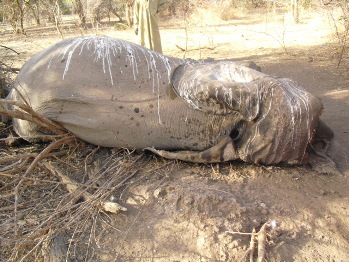

Poached elephant: poachers cut off the trunk and sometimes the head to get at the ivory tusks. Photo courtesy of Stephanie Vergniault.

"The population of Chadian elephants was around 20,000 in the 1980s, but due to the intensive poaching, it was reduced to a little more than 3,000 today," Vergniault recently told mongabay.com, illustrating a total decline of 85 percent in less than three decades. And that number keeps falling: 105 elephants were killed by poaching in the region of Logon Oriental during the month of April alone. According to Vergniault if poaching continues at this rate not a single elephant will be alive in Chad in three years time.
SOS Elephants is working desperately to establish ways to stop poaching in Chad, yet they face off against poachers who are highly-trained and well-compensated soldiers-of-fortune with access to sophisticated technology, not simple locals driven to kill elephants out of desperate poverty.
"I doubt [the poachers] are living in Chad," Vergniault says. "They have a kind of Arabic nomadic style: traveling by horses divided into small groups of 5, sometimes with camels to carry the ivory. They are apparently former soldiers, since they are very well trained when shooting."
Vergniault says that she believes the poachers have their main base in the Central African Republic, and are likely operating both in Chad and Cameroon. These poachers are also equipped with the latest in technological advances, including GPS and satellite phones. They may even be employing satellite imagery to locate and follow elephant herds.
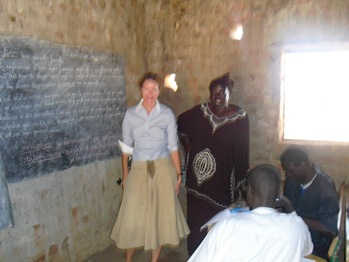

Vergniault works with locals. Photo courtesy of Stephanie Vergniault.

"Due to certain sources that I cannot for the moment reveal, we are really wondering if they are not using satellite pictures to localize the groups of elephants," Vergniault explains. "It is very important for us to understand how the traffic is organized abroad and if the ‚guys‘ behind the traffic have very sophisticated ways to operate and are able guide the poachers due to very high satellite picture, perhaps even military quality?"
Who is ultimately organizing and paying these militia-poachers no one knows. However, the ivory does not stay in Africa, but most likely ends up in far-away China, a nation known for a rich market of illegal wildlife goods.
The only way for SOS Elephants to even begin combating such determined poaching is by working closely with locals and the Chadian government.
"We are slowly establishing a very good network of local informers who have been taught by us to give us the position of poachers or elephants. Due to our very good relationships with the Chadian authorities, we are alerting the Mobile Forces of Protection of the Environment and sometimes even the Head of State to ask him to send troops whenever it is necessary," Vergniault says, adding that the Head of State of Chad, Idriss Deby Itno, has become a heroic ally in the war to save the nation’s elephants.
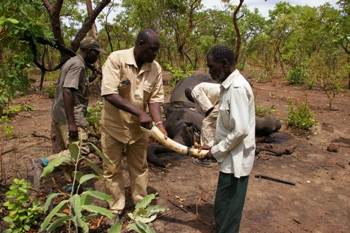

Officials seize ivory with killed elephant in the background. Photo courtesy of Stephanie Vergniault.

The government, Vergniault stresses, has been incredibly helpful. In fact, it’s not only elephants that are losing their lives to poachers‘ ammunition, but Chadian soldiers as well. Last month poachers killed two Chadian soldiers in a single weekend. The elephant wars are a human tragedy just as much as a wildlife one.
Along those lines, SOS Elephants is not content to only work on the poaching issue, but is also helping locals protect their fields from hungry elephant.
"Because we need to enhance the quality of the relationships between elephants and farmers, our second kind of activities is to teach the people how to better protect their crops," says Vergniault, who has worked with farmers to employ red pepper as elephant-repellent, including planting red pepper around their fields.
Historically, Chad’s elephants have migrated both to Cameroon and the Central African Republic using the same corridors for centuries, but recently farmers have moved into many of these corridors planting crops, which has brought sensitive elephants and humans closer together. SOS Elephants is also working with authorities on plans to move people out of the elephant corridors.
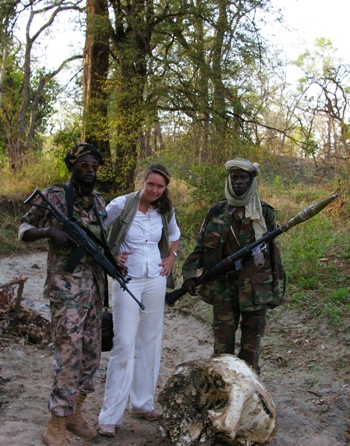

Vergniault overlooks carcass with soldiers for protection. Photo courtesy of Stephanie Vergniault.

"A lot of education should be done with locals to explain that elephants can produce income and that it is [the local’s] duty to alert the authorities when poachers are around," Vergniault says, but adds that saving Chad’s elephants is not just up to Chadians.
"At a greater level the International community should pressure all the states buying [ivory] to condemn it."
As highly-intelligent animals, Vergniault says that the elephants of Chad have not been left psychologically unscarred by the poaching war waged against them. In fact, the constant pursuit by armed killers—and tens-of-thousands of their own dead—have made the elephants of Chad increasingly aggressive, and even murderous.
"Elephants have a very good memory and, in my opinion, most of them are now survivors of a ‚holocaust‘. They have seen other elephants from their groups killed by humans and more and more they are taking their revenge and are becoming serial killers," Vergniault explains. "It is a pity! The remaining elephants of Chad are survivors and their only way to survive is to be very aggressive. For example, every time Chadians elephants see a horseman, they charge! Why? Because poachers are horsemen!"
Elephant poaching is on the rise globally, but in all the media covering the issue the massacred elephants of Chad have been largely ignored: Vergniault hopes to change this.
In a nation still considered unstable—where approximately 80 percent of the population lives below the poverty line and hundreds-of-thousands of refugees have arrived to escape violence in Darfur—saving elephants may appear unimportant next to the scale of human tragedy. Yet, if one is to hope for the future of Chad, and of central Africa in general, one has to believe that species like the elephant can survive the current onslaught—just as one hopes the people will weather the long storm—and continue to inhabit a region where they have roamed for millions of years.
To keep up on the work of SOS Elephants join the Facebook page which sends out regular updates: SOS Elephants Facebook Group.
Questions for Stephanie Vergniault or offers of help? Please feel free to contact her: svergniaul@aol.com
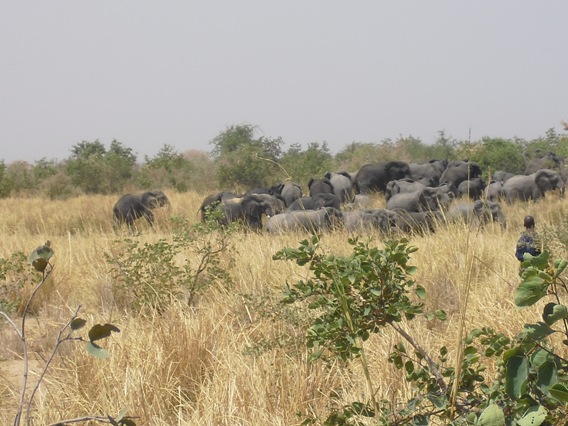
A herd of elephants roaming free in Chad. Photo courtesy of Stephanie Vergniault.
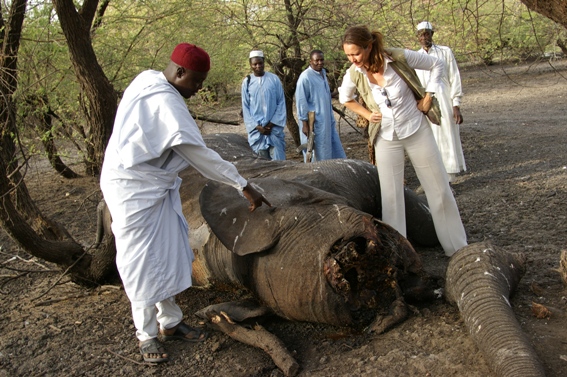
Vergniault inspects an ‚average‘ poaching. Photo courtesy of Stephanie Vergniault.
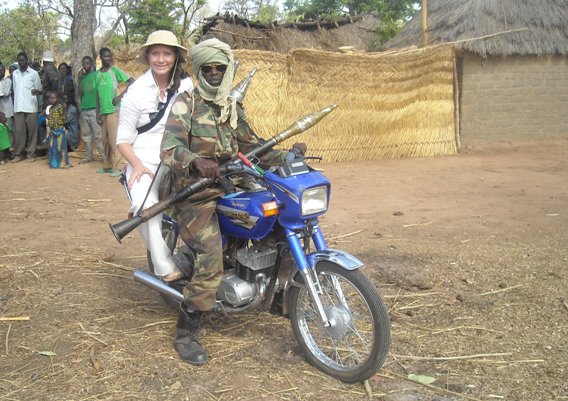
Vergniault rides with a soldier for protection. Photo courtesy of Stephanie Vergniault.
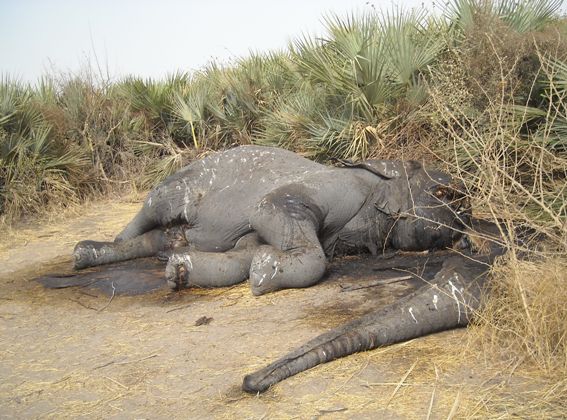
Poached elephant with trunk cut off. Photo courtesy of Stephanie Vergniault.
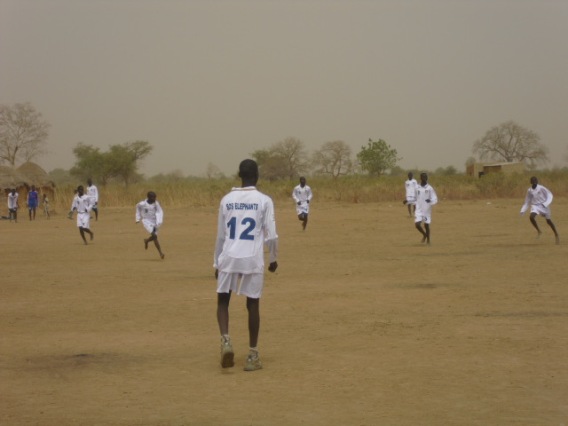
SOS Elephants works closely with local communities. Here they have sponsored a local football team. Photo courtesy of Stephanie Vergniault.
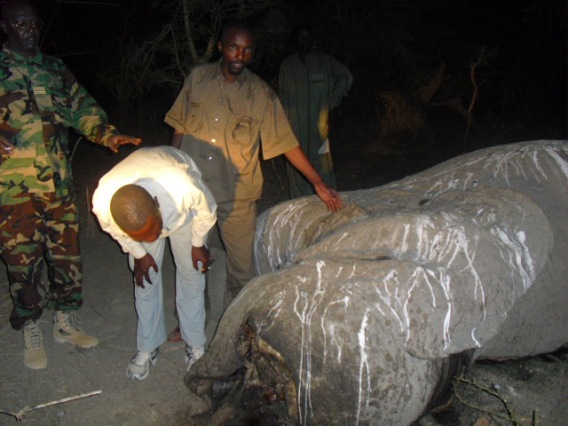
Poached elephant with its head cut off. Photo courtesy of Stephanie Vergniault.
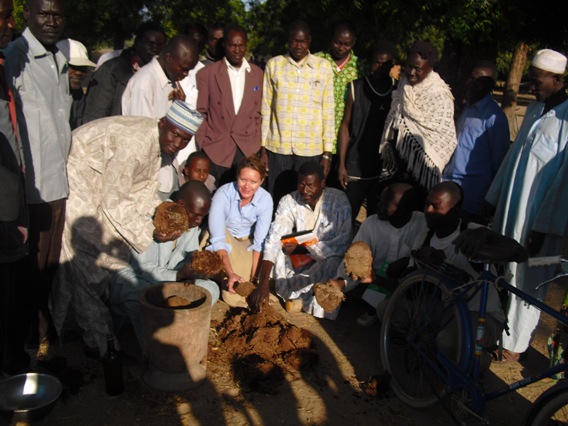
Vergniault working with locals. Photo courtesy of Stephanie Vergniault.
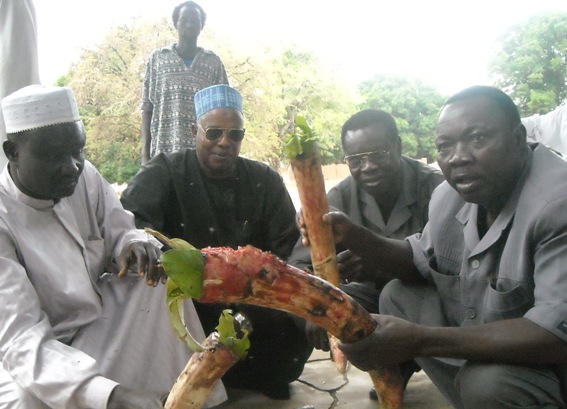
Officials hold up confiscated ivory. Photo courtesy of Stephanie Vergniault.
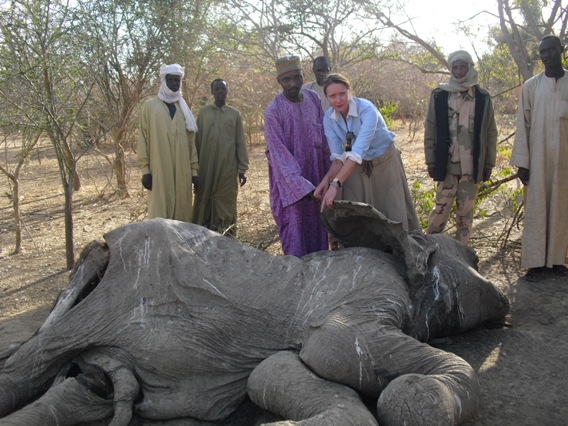
Vergniault examines a poached elephant. Photo courtesy of Stephanie Vergniault.

Source: http://news.mongabay.com/2010/0512-hance_chad.html

Unser  Partnerverein “Verein der Elefantenfreunde“ aus der Schweiz unterstützt Stephanie Vergniault! Our Friends from Switzerland-´s NGO “Verein der Elefantenfreunde“ are supporting Stephanie in Chad!
Kenya: How did the elephant cross the road? Underneath it!

NAIROBI, Kenya (AP)

image

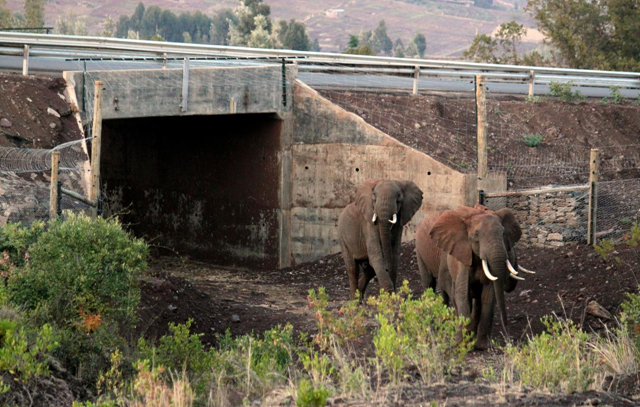
In this photo of Monday, Jan. 24, 2011, elephants exit Africa’s first dedicated elephant underpass near the slopes of Mt. Kenya. Conservationists say the tunnel connects two elephant habitats that had been cut off from each other for years by human development. (AP Photo/Jason Straziuso)

Dusk had settled on Mount Kenya’s forested slopes, and traffic had slowed to a trickle on the region’s major highway. That’s when three elephants crossed through Africa’s first dedicated elephant underpass — a new solution to the increasing problem of animal-human conflict in Africa.

It was 6:47 p.m. when a gleaming set of white tusks poked through the end of the newly built underpass. A second set of tusks appeared. Then a third. Moving cautiously, the three young males climbed a bank of dirt, made a sharp left turn and crashed into the forest.

The $250,000 tunnel — built with donor funds — has successfully connected two wilderness areas and two distinct elephant populations separated for years by human development. The elephants successfully crossed a major road without putting themselves or motorists in danger, and without damaging crops or scaring residents in a nearby village.

"The first time we had a report about an elephant going under the underpass it was very exciting. We didn’t expect it to happen so quickly," said Susie Weeks, executive officer of the Mount Kenya Trust, one of the partners in the tunnel project. "They actually managed to go through it within days of it being opened."

The 15-foot-high (4.5-meter-high) tunnel opened for elephant business around Christmas, and on Jan. 1 a bull elephant named Tony made the first crossing. Accompanied by two other young males, Tony moved through the underpass again on Monday as an Associated Press reporter captured the first ever photos and video of elephants making use of the underpass.

Africa’s wildlife is coming under increasing pressure from human development. Villages are being built and crops raised in areas that for centuries were animal wildlands. The new elephant underpass reconnected wilderness areas on Mount Kenya’s highlands and the lower forests and plains, linking 2,000 elephants on Mt. Kenya with 5,000 more below.

Iain Douglas-Hamilton, the founder of Save The Elephants, said the 9-mile (14-kilometer) man-made corridor that surrounds the tunnel allows elephants to move from low to high to search for food and mates. The fenced-in corridor will also help strengthen the elephants‘ gene pool. The overall corridor and tunnel project cost $1 million.

"All over Africa this incredible wildlife is increasingly being fragmented by the growing human population, and if African wildlife is to survive, solutions must be found of this nature, where connectivity is preserved through corridors," he said.

"I think it’s a good example of the compromises that can be made between human interest and the survival of wild animals," he added.

The underpass is somewhat pricey, Douglas-Hamilton said. Cheaper solutions will also need to be found, including points where traffic will be stopped so elephants can cross the road, he said.

Kenya’s elephant underpass may be the first in Africa but not the world. China and India have elephant underpasses, and India even has elephant overpasses. In the U.S., a winner was announced Sunday in a contest to design a highway wildlife crossing in Vail, Colorado aimed at reducing collisions between cars and deer, coyote and bighorn sheep.

In South Africa’s Addo Elephant National Park, which is fragmented by roads and railway lines, officials recently opened an elephant crossing over a road, said Megan Taplin, a park spokeswoman. She said officials have considered overhead bridges that are wide and full of vegetation to help elephants move around.

Kenya’s underpass was 10 years in the making, and didn’t gather much momentum until Richard Branson, owner of Virgin Atlantic, donated $250,000. The Dutch government kicked in more money and other donors stepped up. Two major farms allowed the corridor to cross through their land.

One of those family farms gave up 671 acres to the corridor. The elephants have already caused $25,000 in damage, but farm owner-manager Charlie Dyer said he is "just overjoyed and really, really satisfied" to see the underpass in use.

The project had many skeptics, people who feared the elephants wouldn’t walk through a tunnel that humans had built.

"So many people were wondering, are we putting good money into this?" said Weeks. But so far about three dozen elephants passes have been made, providing conservationists with the answer they were hoping for.

The tunnel sits in the rolling hills below Mount Kenya, near fields of young green wheat and bright yellow canola stalks. It was lined with hay and elephant dung to entice the animals through. The bucolic lands can be dangerous, though.

Poaching is on the upswing, fueled by demand for ivory in China. John Pameri, the senior warden at the Lewa Wildlife Conservancy, one of the partners in the underpass project, said poachers killed more than 30 elephants in northern Kenya in December. Because elephant tusks have increased in value, poaching is "really a big, big danger," Pameri said.

Save the Elephants has put GPS collars on several elephants and can track their movements. Three minutes after Tony crossed through the tunnel Monday, an automatic text message alert went out to people like Weeks and Douglas-Hamilton, who has since watched Tony climb to the top of the elephant corridor on a Save The Elephants Google Earth maps program.

"This particular corridor is almost a symbol. It’s a very high profile one under the peaks of Mount Kenya, and what happens there is important for Kenya and for Africa in terms of conservancy of elephants and biodiversity," Douglas-Hamilton said.

Source: www.google.com/hostednews/ap/article/ALeqM5jxOcuItiGlgm7LlEUZhbRNe-dzHg?docId=cffdba0c740a47d389843bde34d01eb3

Elefantenjagd mit Kohlenstoff-Isotopen

Ein neues Verfahren soll Elefanten-Wilderern das Handwerk legen. Der Trick: Mithilfe einer C-14-Isotopen-Methode lässt sich die Herkunft der Elefanten ziemlich genau bestimmen.

VON MARC ENGELHARDT

image 

Elefanten im Masai Mara Nationalpark (Kenia). Foto: dpa

Nur Stunden, bevor die Vertreter von 35 afrikanischen Staaten sich in Kenias Hauptstadt Nairobi zu einer UN-Elefantenschutz-Konferenz zusammensetzten, hörten Wildhüter im knapp 400 Kilometer entfernten Meru-Nationalpark Schüsse in der Savanne. "Unsere Patrouille machte sich sofort auf die Suche nach dem Tatort", berichtet Samuel Tokore, der die Operation in Meru leitete. "Dort stießen wir auf eine Gruppe, die gerade dabei war, mit einer Machete die Stoßzähne aus einem jungen Elefantenbullen zu hacken." Die Wilderer eröffneten sofort das Feuer, im Kugelhagel wurde einer von ihnen erschossen. "Wenn wir Wilderer finden, dann gehen wir kein Risiko ein", erklärt Tokore den Todesschuss, bei weitem nicht der einzige in diesem Jahr.

Für Wildhüter wie Tokore wird der Kampf gegen Wilderer immer gefährlicher. "Der illegale Elfenbeinhandel ist mafiös organisiert", weiß Stefan Ziegler vom WWF. "In einigen Regionen in Zentralafrika ziehen gut ausgerüstete Banden mit Schnellfeuerwaffen und Walkie-Talkies für einige Tage durch die Schutzgebiete, laden die Beute auf einen Pick-up und flüchten." Oft handelt es sich Ziegler zufolge um Auftragsarbeiten im Dienste von Kartellen, die das Elfenbein in Schiffscontainern mit doppelten Böden nach Asien schmuggeln. Die mit Abstand meisten Käufer sitzen in Japan und China, wo Elfenbeinschnitzereien begehrt sind und Elfenbeinpulver traditionellen Medikamenten und Kosmetika beigemischt wird. Bis zu 400 Tonnen Elfenbein, die Stoßzähne von 10.000 Elefanten, werden Schätzungen zufolge jährlich auf dem Schwarzmarkt verkauft.

Zwar verbietet das Washingtoner Artenschutzabkommen nahezu jeden Handel mit Elfenbein, doch bislang war es kaum möglich, Herkunft und Alter von Stoßzähnen zu bestimmen. Oft behaupten ertappte Hehler, es handele sich um antike Stücke oder um legal versteigertes Elfenbein aus Südafrika, Namibia, Botswana oder Simbabwe. Doch damit soll bald Schluss sein. Ein neuartiges Verfahren, das von den Unis Regensburg und Mainz entwickelt und von Ziegler in Nairobi vorgestellt wurde, ermöglicht die genaue Bestimmung der Herkunft des Elfenbeins. "Wir messen dazu das Vorkommen bestimmter Isotopen, also Elementen mit unterschiedlicher Masse", so Ziegler. Weil etwa Waldelefanten sich vorwiegend von Blättern ernähren, nimmt ihr Körper weniger Kohlenstoff-14 auf als Elefanten in der Savanne, die vor allem Gras zu sich nehmen. "An den Zähnen lässt sich das genau ablesen", erklärt Ziegler. Mit einem einfachen Verfahren, das in Europa auch bei Lebensmittelkontrollen benutzt wird, lassen sich die Isotopenverhältnisse ablesen. "Wenn wir das für sechs Isotopen machen und die Ergebnisse mit einer Referenzdatenbank abgleichen, wissen wir sofort, aus welcher Ecke Afrikas das Elfenbein stammt."

Genau diese Referenzdatenbank soll in den kommenden Monaten erstellt werden, indem Proben in allen Staaten gesammelt werden, wo Elefanten leben. Doch Ziegler rechnet mit Widerstand. "Manche Staaten, vor allem in Zentralafrika, lassen sich natürlich nicht gerne gerichtsfest nachweisen, dass sie schlechten Artenschutz praktizieren – außerdem profitieren in manchen Ländern Politiker bis ganz nach oben vom illegalen Elfenbeinhandel." Doch Ziegler hat vorgesorgt: Abkommen mit Jagdverbänden und Museen sollen helfen, auch aus unwilligen Ländern die nötigen Daten zu erhalten.

Quelle: www.taz.de/1/zukunft/umwelt/artikel/1/elefantenjagd-mit-kohlenstoff-isotopen/

Nigeria: Stop Killing of Elephants, Wildlife Officer Tells Locals

Mr John Mshelbwala, a Wildlife Officer with the Federal Ministry of Environment, has warned Nigerians to desist from killing elephants.Mshelbwala, who gave the warning in Abuja yesterday, said the animals play crucial role in sustaining and conserving the environment.

He said the warning was necessary due to the high rate of extinction of elephants in recent times in the country.Mshelbwala said the population of the animals had drastically reduced to 1,600 in savannah grassland and other forest reserves in the country due to the high rate of poaching activities.

The wildlife officer said the high rate of extinction of elephants was caused mainly by human activities.Mshelbwala added that preventing the untimely death of the animals would ensure equilibrium of the ecosystem.

"Plants, other species of animals, ants and bees, among others, benefit from the survival of elephants in the forest," he said.Mshelbwala said elephants also assist in opening forest cover, saying that removing them from the ecosystem would lead to the collapse of forest cover.

Mshelbwala urged all stakeholders to ensure that the animal does not go into extinction.

NAN

Source: http://allafrica.com/stories/201101060552.html

NAIPOKI – eine neue Waise in Nairobi/ a new orphan in Nairobi

 
Gestern wurde wieder eine neue Waise im Norden Kenias gerettet: Die kleine NAIPOKI. Angehörige des Stammes der Samburu in der Namunyak Conservancy (Namunyak Schutzgebiet) riefen über den KWS, die kenianische Wildschutzbehörde, den David Sheldrick Wildlife Trust zu Hilfe. Das kleine, ca. 3 Monate alte Elefantenmädchen fiel, wie schon so viele Waisen vorher, in ein von Menschen gegrabenes Wasserbohrloch. Während der Nacht wurde ihr Rüsselchen von Raubtieren angefressen, trotz allem wirkt sie gesund und kräftig. Alles Gute kleine NAIPOKI!

164439_495492884888_120805694888_5554580_6077062_n

Die kleine Naipoki mit den Keepern Abdullah und Hassan am Flugfeld der Sarara Lodge.

Another rescue – a tiny calf  came into our care when reported by the Namunyak Conservancy through The Kenya Wildlife Trust and Sarara Camp, early this morning. She was discovered fallen down a well, and rescued by Samburu herdsmen. Her trunk has been chewed by predators, which obviously happened while she remained trapped in the well overnight. We have named her Naipoki and estimate her age to be around 3 months.